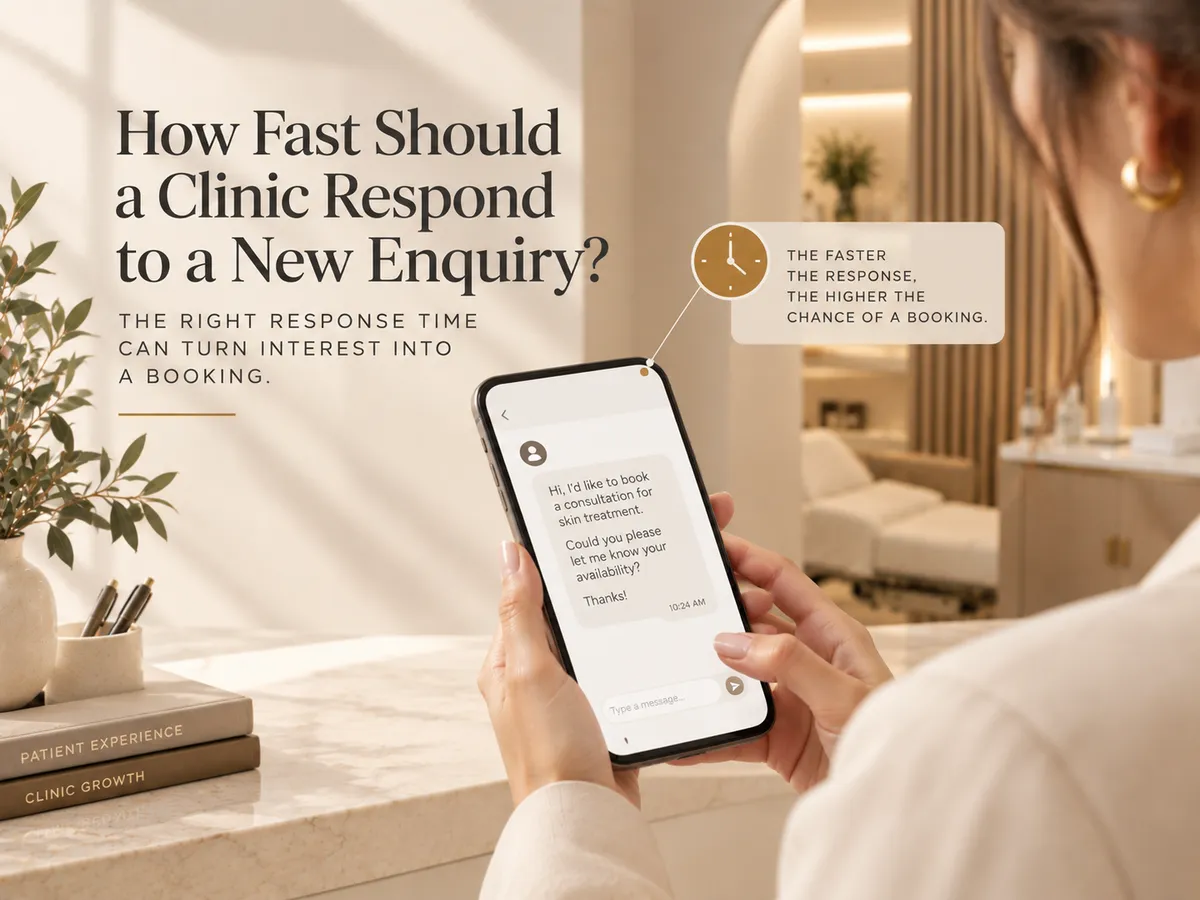
How Fast Should a Clinic Respond to a New Enquiry?
A potential patient sends your aesthetic clinic a message asking about a treatment. Your team is busy, the enquiry sits unanswered, and the person may move on to another clinic.
In a competitive market, response time can influence the patient experience and your opportunity to convert an enquiry into a booking.
There is no single response time that guarantees a booking. However, establishing a clear and timely follow-up process can help your clinic respond more consistently.
1. Why Response Time Matters
When someone enquires about a treatment, they may be comparing clinics, exploring prices, or ready to schedule an appointment.
A delayed response can mean the person loses interest, finds another provider, or forgets about the enquiry. A timely reply gives your clinic an opportunity to answer questions while the enquiry is still relevant.
Response time is one part of conversion. The quality of the response, treatment suitability, pricing, and booking experience also influence the outcome.
2. How Quickly Should Your Clinic Respond?
Aim to acknowledge new enquiries as quickly as reasonably possible, with a clear internal target for a human response.
For example, your clinic may establish a goal of responding to new enquiries within 5–15 minutes during staffed hours, depending on its capacity and communication channels. This is an operational target, not a universal industry benchmark or guarantee of improved conversion.
Outside operating hours, an automated acknowledgement can explain when the team will respond and provide relevant booking information where appropriate.
The most important step is to choose a realistic standard and measure whether your clinic consistently meets it.
3. Create an Immediate Enquiry Acknowledgement
If your team cannot respond immediately, an automated message can help confirm that the enquiry has been received.
For example:
"Thank you for contacting us. Our team has received your enquiry and will get back to you as soon as possible. If you have a booking question, please let us know how we can help."
An acknowledgement should not imply that a qualified clinician has reviewed the enquiry when that has not happened.
4. Use AI to Support Faster Responses
Busy reception teams may struggle to respond to every enquiry manually.
An AI-supported reception or CRM system can help acknowledge messages, organise incoming leads, provide approved general information, and route enquiries to the appropriate team member.
For treatment-related questions, clinical advice, and suitability assessments, qualified staff should remain responsible for appropriate review and communication.
The aim is to reduce unnecessary delays while maintaining a reliable patient experience.
5. Measure Your Response Time
You cannot improve enquiry handling without visibility into your current performance.
Track:
Average first response time.
Number of enquiries received.
Enquiries awaiting a response.
Enquiry-to-booking conversion rate.
Bookings generated through follow-up.
Review these metrics by channel, such as website forms, social media, and phone enquiries, to identify where your process may need improvement.
Build a More Responsive Enquiry-to-Booking System
Fast responses are valuable, but speed alone does not guarantee revenue. Your clinic needs a process that combines timely communication, relevant information, and a straightforward booking journey.
At Brand Xcellence, we help aesthetic clinics and salons explore AI-powered marketing and revenue systems designed to support lead follow-up, client acquisition, retention, and operational efficiency.


