
Lead Generation Statistics That Will Transform Your Strategy in 2026
A no-fluff breakdown for marketers who are tired of spinning their wheels.
Let's be blunt: most businesses are terrible at lead generation - not because they're not generating leads, but because they don't know what to do once they have them.
Here's a number that should keep you up at night: 79% of marketing leads never turn into a sale. Not because the product is bad. Not because the market doesn't exist. But because the follow-up is broken.
So before you pump more budget into top-of-funnel tactics, let's look at what the data actually says about what's working in lead generation in 2026 — and what's quietly bleeding your pipeline dry.
The Baseline: Where Most Businesses Actually Stand in Lead Generation
The average company generates around 1,877 leads per month. Sounds decent, right? But here's the catch — the average lead conversion rate across industries sits at just 2.46%.
Do the math. That's roughly 46 customers from nearly 2,000 leads. Every. Single. Month.
The cost per lead? The average organic cost per lead runs at $409, with the mean cost per lead across industries at around $198. You're spending real money to attract people who mostly ghost you.
And yet, 91% of marketers say lead generation is their #1 priority. So the ambition is there. The execution? That's where things fall apart.
The Follow-Up Problem Is Way Bigger Than You Think
Here's something that doesn't get talked about enough in any lead generation strategy: only 20% of sales-qualified leads actually get proper follow-up.
That means 4 out of 5 warm, sales-ready leads are just... sitting there. Untouched.
Meanwhile, research shows that businesses who respond to a new inquiry within the first hour are 7x more likely to qualify that lead than those who wait even a few hours longer. Speed is one of the most underrated lead conversion tactics out there.
The leads aren't the problem. The process after the lead is captured is the problem.
Personalization Isn't Optional in Modern Lead Nurturing
If you're still sending generic "Hey [First Name]" emails, you're already behind.
Companies that invest in proper lead nurturing — with actual personalization — generate 50% more sales-ready leads at 33% lower cost. Nurtured leads also tend to spend more when they do buy: up to 47% larger purchases compared to leads that were never nurtured.
And it's not just nurturing — it starts at the very first touchpoint. Emails with personalized subject lines see a 26% jump in open rates. Hyper-personalized subject lines can push that even further, with some studies showing 30.5% higher open rates.
Segmented email campaigns outperform generic blasts with a 14.31% higher open rate and a staggering 100.95% higher click-through rate. That's not a marginal difference — that's a completely different outcome.
Quick Stat: Personalization in lead nurturing can boost conversion rates by up to 63%. If you're not segmenting your audience, you're leaving conversions on the table.
Social Media Lead Generation: Stop Treating It Like a Megaphone
Social media lead generation works — but only if you stop treating it like a billboard.
68% of marketers report that social platforms have directly helped them generate leads. But the platform matters enormously depending on who you're selling to.
LinkedIn Lead Generation for B2B
If you're B2B, LinkedIn is where deals actually start — 80% of B2B leads are sourced from the platform. And with nearly a third of B2B marketers now using LinkedIn automation tools, the competition for attention is only going up.
Facebook and Instagram for B2C Lead Generation
Facebook still dominates for consumer-facing brands, with a 62% effectiveness rate for lead generation. Instagram is catching up fast — its lead generation effectiveness has grown by 115% over the last two years.
One underrated stat: marketers who dedicate just six hours per week to social media report generating noticeably better quality leads. It's not about being everywhere. It's about showing up consistently in the right place.
Content Marketing for Lead Generation: What Actually Works
Content Marketing for Lead Generation: What Actually Works
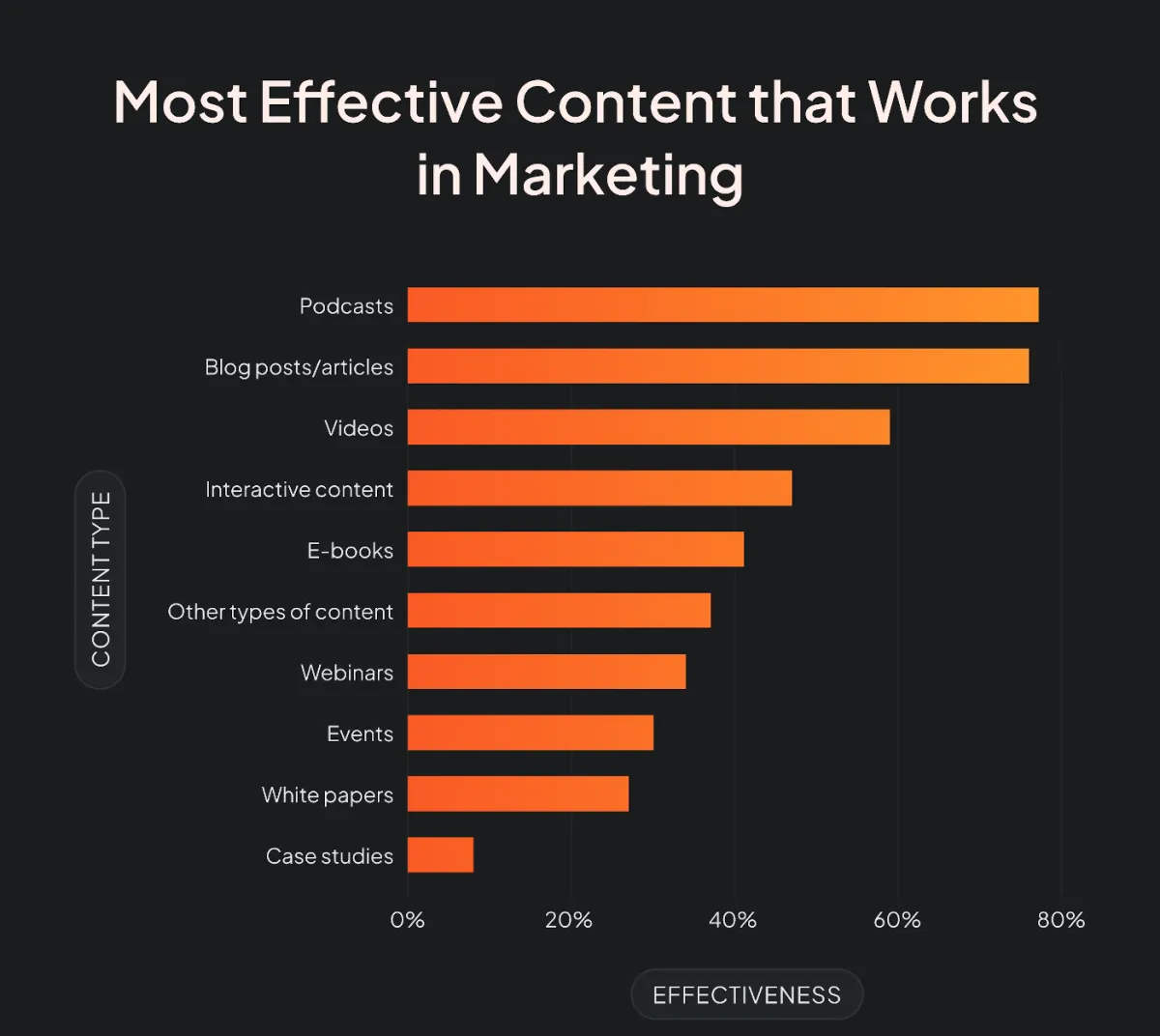
Content marketing for lead generation works. But not all content works equally.
Companies that blog consistently generate 67% more leads than those that don't publish. Long-form content, specifically, generates 9x more leads than short-form pieces — and 8x more page views. The depth of your content signals the depth of your expertise.
Case studies are quietly one of the highest-performing formats for B2B — 73% of B2B marketers use them as a core lead generation tool. Nothing sells like proof.
Interactive content (think quizzes, assessments, calculators) generates twice as many conversions as passive content like blog posts or whitepapers. If you haven't experimented with interactivity yet, you're leaving conversions on the table.
One quick win that's almost criminally underused: updating and republishing old blog posts can increase organic traffic by up to 106%. You don't always need to create something new. Sometimes you just need to make what you have better.
Email Marketing Lead Generation: Still the Highest ROI Channel
With all the noise around social and paid channels, email marketing for lead generation keeps quietly delivering.
89% of marketers rely on email as a primary lead generation channel. Automated email sequences alone generate 320% more revenue than manually sent campaigns — which means if you're not automating your nurture flows, you're doing this on hard mode for no reason.
Welcome emails have an average open rate of 82%. That first email after someone signs up is your highest-attention moment. Treat it accordingly.
Cold outreach? It's not dead, but the bar is higher. Average reply rates for cold email campaigns sit between 8–10%, which means your messaging, targeting, and timing all have to be on point. One batch-and-blast approach won't cut it.
Where Businesses Are Actually Losing Leads
Let's talk about the honest challenges — because most marketers are dealing with the same lead generation problems:
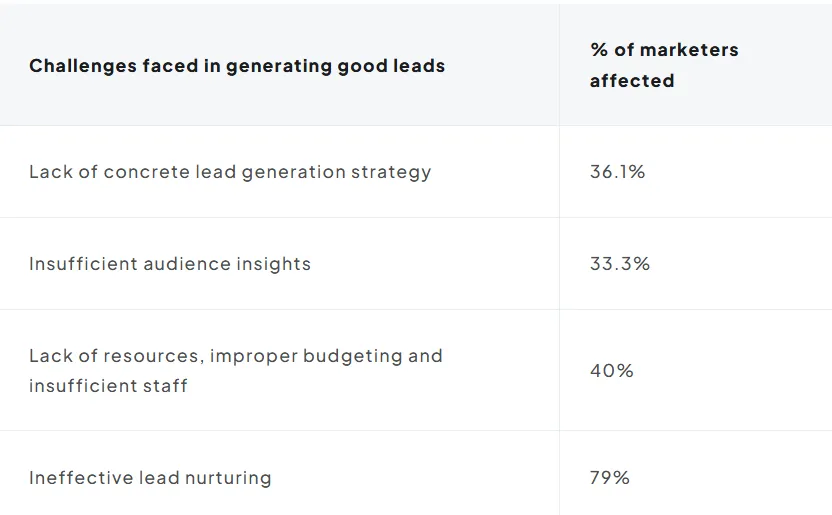
These aren't technology problems. They're strategy and process problems. Throwing more ad spend at a broken funnel just burns money faster.
Lead generation in 2026 isn't about generating more leads. It's about doing more with the leads you already have.
The businesses winning right now are the ones that respond faster, nurture smarter, personalize relentlessly, and align their sales and marketing teams around the same goal. Companies with strong sales-marketing alignment report 34% higher revenue growth — that's not a coincidence.
The playbook exists. The data is clear. The only question is whether you'll act on it before your competitors do.
Want to audit your current lead generation funnel? Start with your follow-up process — it's almost certainly where the biggest opportunities are hiding.
The Bottom Line: Lead Generation in 2026 Is About Quality, Not Quantity
Lead generation in 2026 isn't about generating more leads. It's about doing more with the leads you already have.
The businesses winning right now are the ones that respond faster, nurture smarter, personalize relentlessly, and align their sales and marketing teams around the same goal. Companies with strong sales-marketing alignment report 34% higher revenue growth — that's not a coincidence.
The playbook exists. The data is clear. The only question is whether you'll act on it before your competitors do.
Want to audit your current lead generation funnel? Start with your follow-up process — it's almost certainly where the biggest opportunities are hiding.
Frequently Asked Questions About Lead Generation
What is the average lead conversion rate? The average lead conversion rate across industries is 2.46%. However, companies that invest in lead nurturing and personalization consistently outperform this benchmark.
Why do most leads fail to convert? 79% of leads fail to convert primarily due to poor follow-up and ineffective lead nurturing. Most businesses capture leads but lack a structured process to move them through the funnel.
What is the most effective lead generation channel in 2026? Email marketing remains the top channel, with 89% of marketers relying on it. For B2B, LinkedIn drives 80% of leads. Content marketing and social media are strong supporting channels when used with clear intent.
How quickly should you follow up on a new lead? Within the first hour. Businesses that respond within 60 minutes are 7x more likely to qualify a lead compared to those who wait longer.
What does lead nurturing actually mean? Lead nurturing is the process of building relationships with potential customers at every stage of the sales funnel through personalized, relevant communication — typically via email sequences, retargeting, and content — until they're ready to buy.
How much does lead generation cost on average? The mean cost per lead across industries is $198.44, while the average organic cost per lead is $409.07. Costs vary significantly by industry and channel.
Contributor,
Urvvi Patel
Founder: Brand Xcellence
Contact Us
Get in touch with us today to discuss how we can help elevate your brand through expert digital marketing solutions.